
Brief Resilience Scale – resilience self-check
Six statements on the ability to bounce back from stress. Three items are reverse-scored; the result is a mean from 1.00 to 5.00.
The live demo opens the real questionnaire — no signup required.
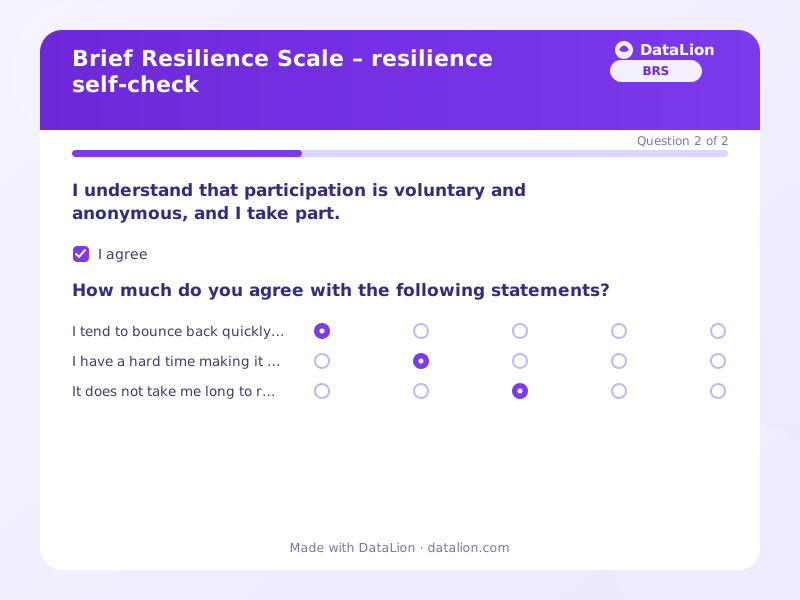
The Brief Resilience Scale by Smith and colleagues measures resilience in its original sense: the ability to bounce back from stress – not optimism, toughness or endurance. Six statements are answered on a five-point agreement scale, three of them reverse-worded. The mean of all six items gives a value between 1.00 and 5.00; below 3.00 counts as low and above 4.30 as high. Those reverse items make the scale a good example of careful scoring: without correct reversal the results are systematically wrong.
When should you use this template?
This template is a great fit for:
- As a self-check in health and leadership programmes
- To prepare for a coaching or counselling conversation
- As a repeated measure before and after a demanding period
Every question in this template
- 1Consent
I understand that participation is voluntary and anonymous, and I take part. *
- 2Matrix
How much do you agree with the following statements? *
Please answer spontaneously – there are no right or wrong answers.
Strongly disagree Disagree Neutral Agree Strongly agree I tend to bounce back quickly after hard times. I have a hard time making it through stressful events. It does not take me long to recover from a stressful event. It is hard for me to snap back when something bad happens. I usually come through difficult times with little trouble.
Related survey templates
- Psychosocial Risk Assessment (Workplace)Anonymous employee survey to fulfil the psychosocial risk assessment required under the German Occupational Safety Act (§5 ArbSchG), along the recognised GDA assessment areas.
- AI Literacy Assessment (EU AI Act Art. 4)Anonymous self-assessment of your employees' AI literacy – as a needs analysis and documentation basis for the training obligation under Article 4 of the EU AI Act.
- Psychological Safety in TeamsMeasures, following Amy Edmondson, whether team members can take risks, admit mistakes and voice concerns – the strongest known predictor of team performance.
- Recovery Experience (REQ)Four ways of refuelling after work: detachment, relaxation, mastery and control – shown as a profile across all four dimensions.
Frequently asked questions
Why are three items reverse-worded?
How is the score calculated?
Start with this template
Load the template into DataLion, adapt it to your brand and start collecting responses — GDPR-compliant, in minutes.