
Question types
32 question types for real market research
From single choice to IAT, Kano, PSM, A/B testing and AI follow-ups: every type runs through the same editor and mobile runner, then lands in the analysis-ready dataset with the right structure.
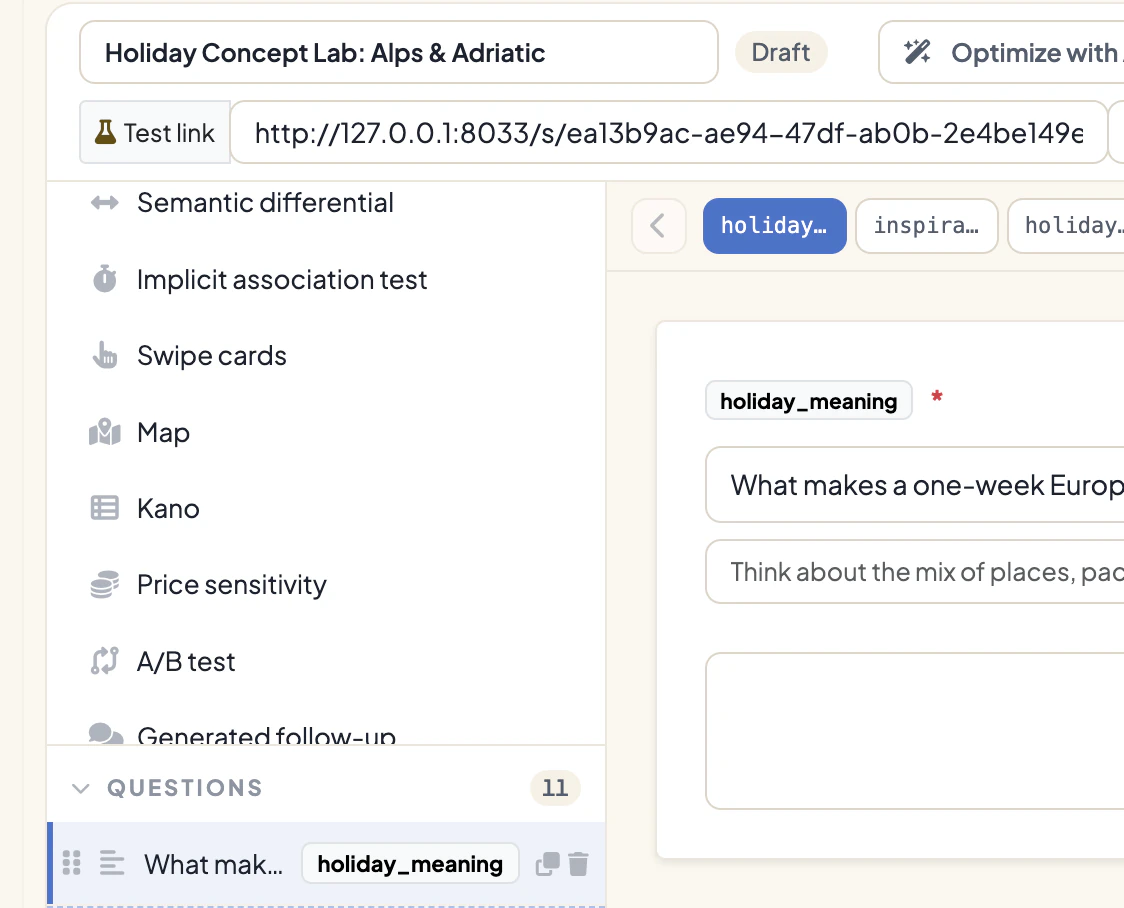
DataLion offers 32 question types plus description blocks. Beyond choice, matrix, NPS, MaxDiff and conjoint, the catalog includes semantic differential, IAT, swipe cards, map markers, Kano, Van Westendorp price sensitivity, A/B tests, file uploads and AI-generated follow-ups. The editor, mobile runner, validation, persistence and dataset export support every type end to end.
- 🇩🇪 Made in Munich
- GDPR-compliant
- DPA included
- Hosted in Germany
- 🌐 Interface in EN, DE, FR, ES, IT & NL
Trusted by research institutes, brands & insights teams






- 50+ interactive chart types
- 20+ statistical methods
- SPSS · Excel · CSV import without data loss
- ISO 27001 certified data centers (Germany)
The classics are all still there
For classic questionnaires you get single and multiple choice, dropdown, picture choice, rating, NPS, single and multi-select matrices, ranking, constant sum, slider, date, number, short and long text, emoji scale, swarm, gauge, hotspot, contact, consent, MaxDiff and conjoint.
Multiple choice still expands into one 0/1 column per option and a matrix into one variable per row. Description blocks structure longer questionnaires without collecting an answer.
- Choice, scales, matrix, text, date and contact
- Interactive swarm, gauge and hotspot questions
- Native MaxDiff and choice-based conjoint tasks
- Automatically labelled variables instead of later recoding
Semantic differential with clearly anchored poles
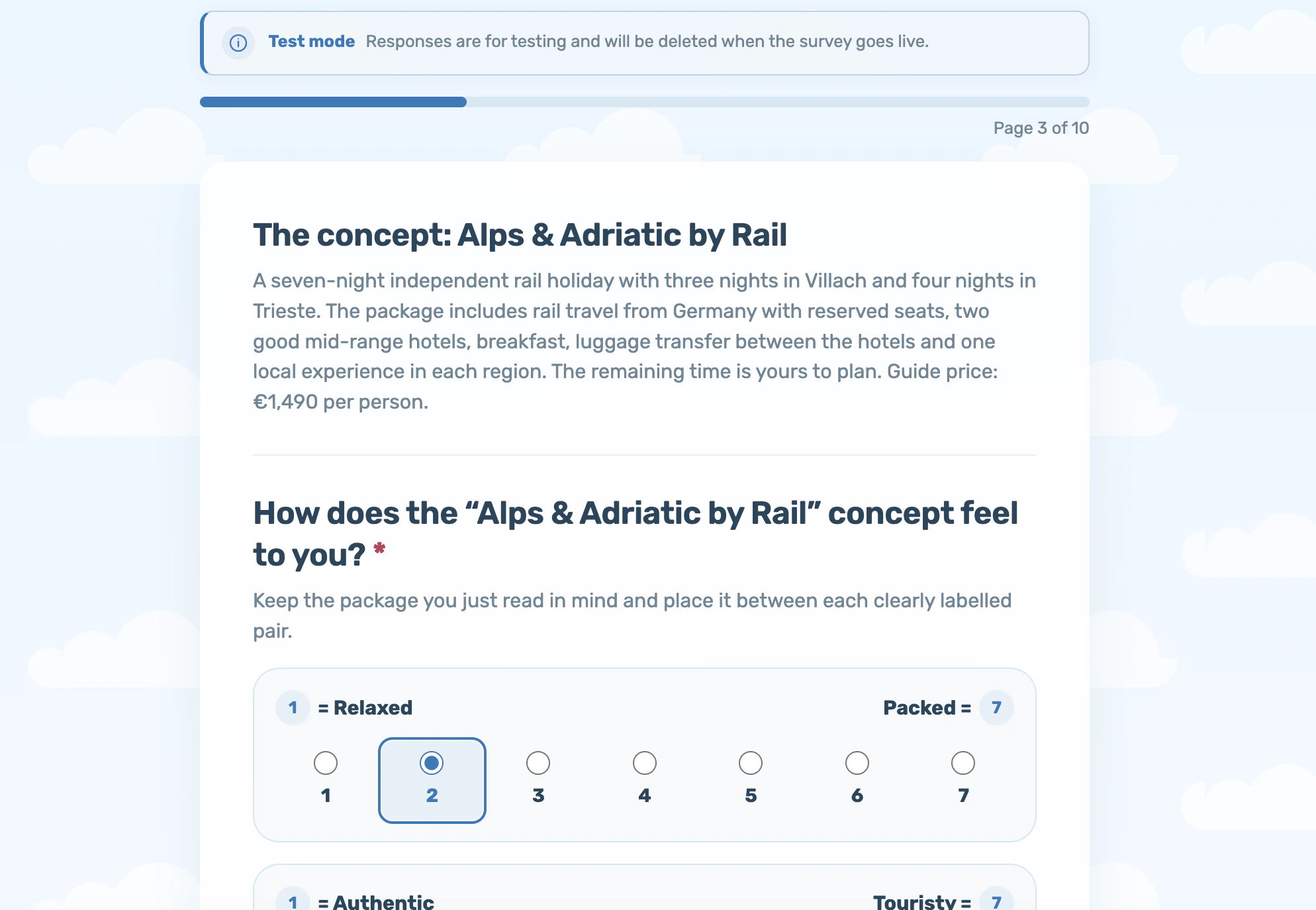
A semantic differential positions a concept between labelled opposites, such as relaxed versus packed or authentic versus touristy. You configure the scale minimum and maximum; every pair becomes its own numeric variable.
The poles stay attached to the endpoint values. It sounds like a small detail, but saves respondents a surprising amount of guesswork.
IAT with reaction time, error rate and D-score
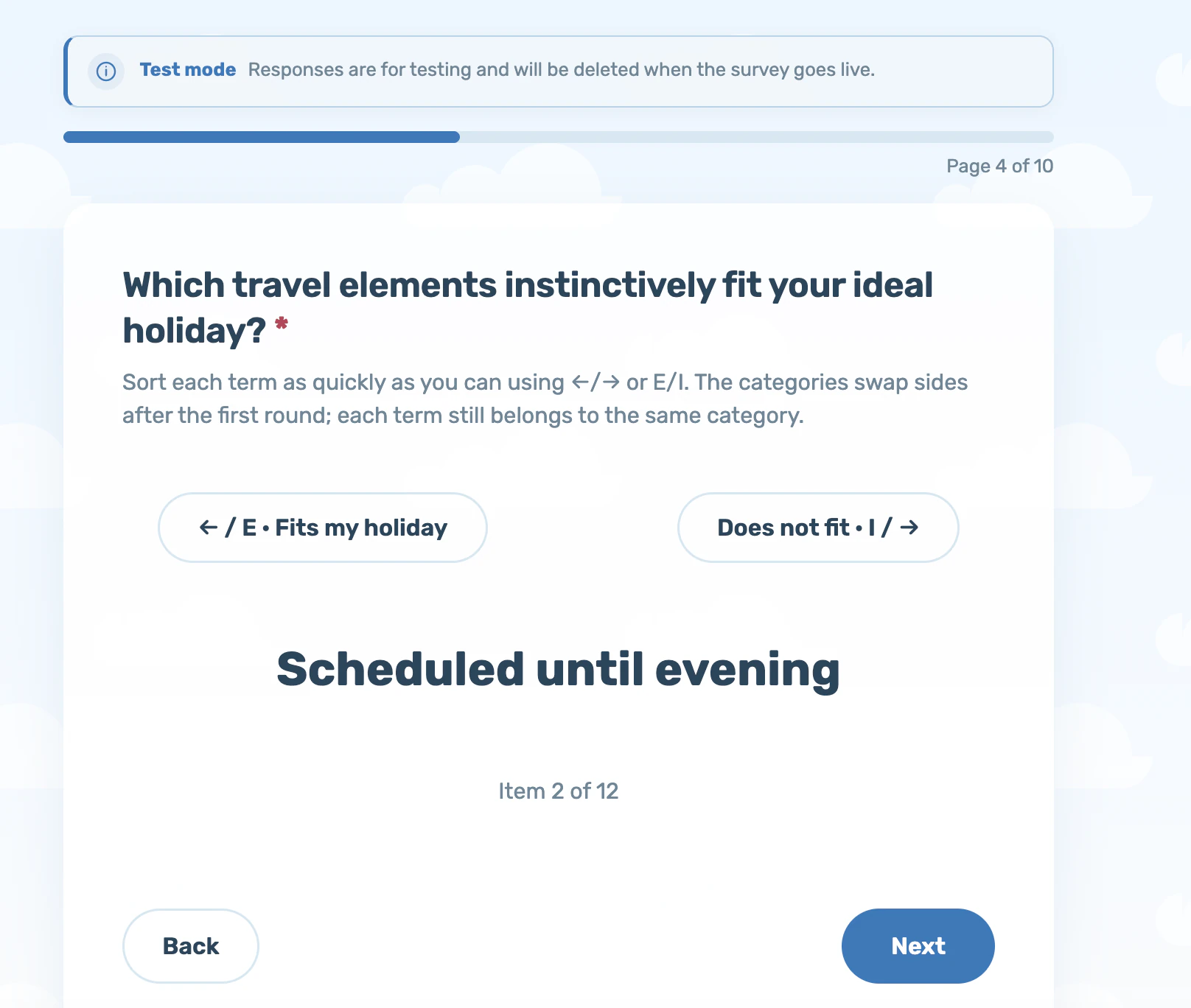
The Implicit Association Test (IAT) asks respondents to categorize terms quickly with the arrow keys or E/I. Categories switch sides in a controlled way; an assigned version remains stable when a response is resumed.
The dataset contains version, D-score, error rate and median latency. That carries both the decision and the speed of classification straight into analysis.
Swipe cards with no, neutral and yes
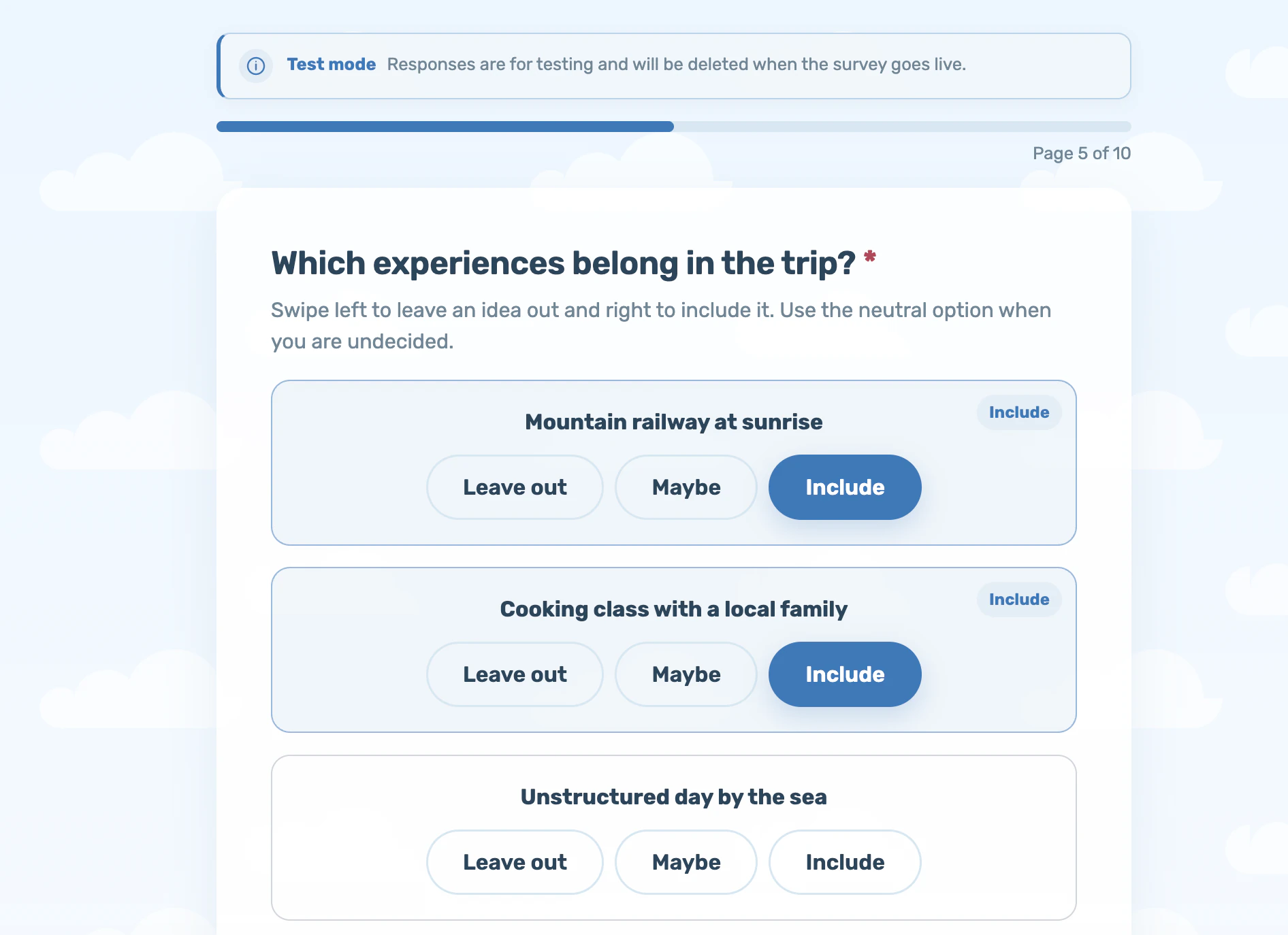
Swipe cards let people exclude, mark neutral or include ideas with a swipe gesture or buttons. Labels, images and order are configurable; the neutral option is optional.
Every card becomes its own categorical variable, ready to filter, crosstab and visualize like an item battery.
Map markers instead of a vague location list
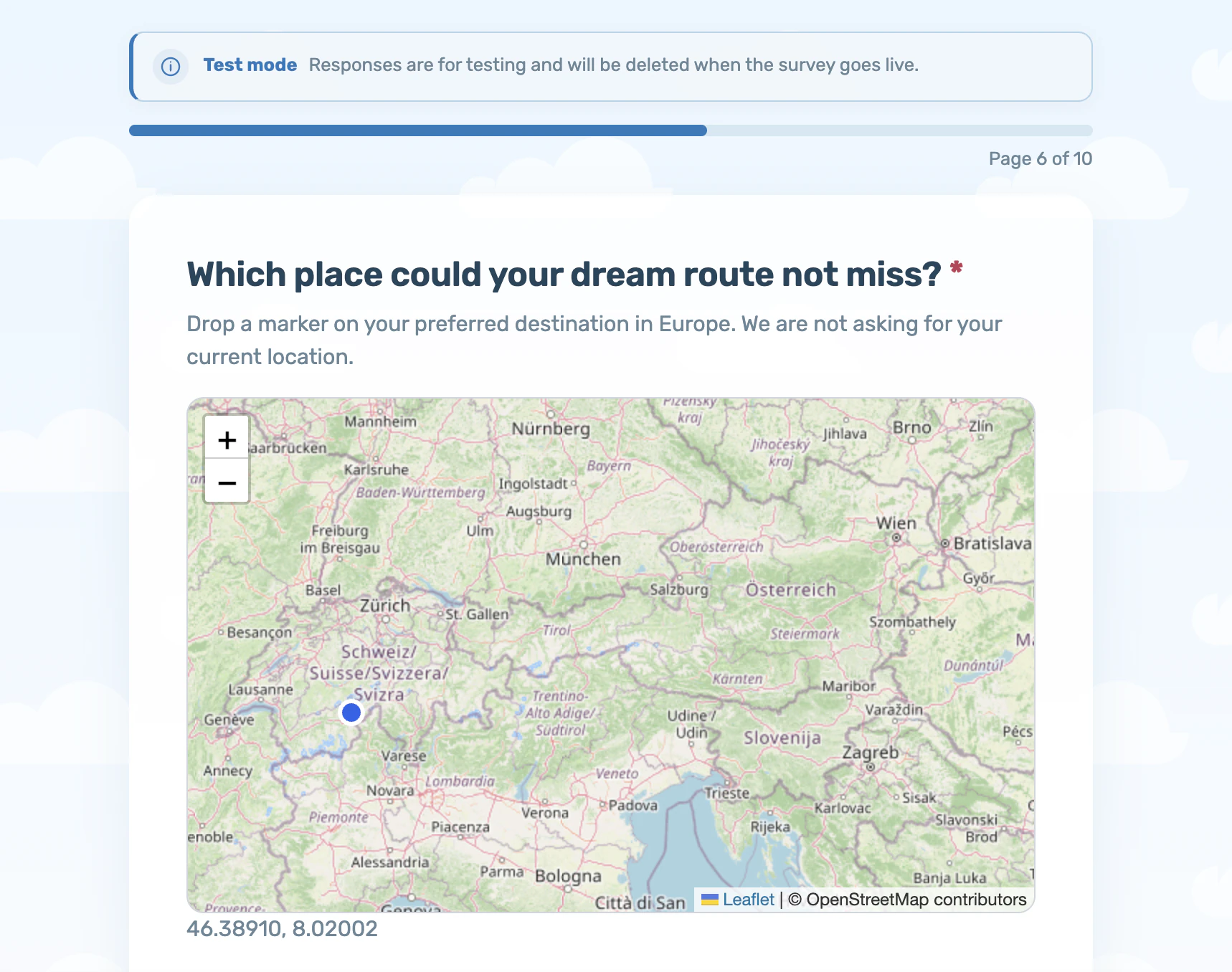
The map question lets respondents place a marker on a zoomable map. You set the centre and zoom in the editor; the answer lands as latitude and longitude in the dataset.
It fits desired destinations, store locations, routes, neighbourhoods or any spatial context where a dropdown is simply too coarse.
Kano questions classify must-haves and delighters
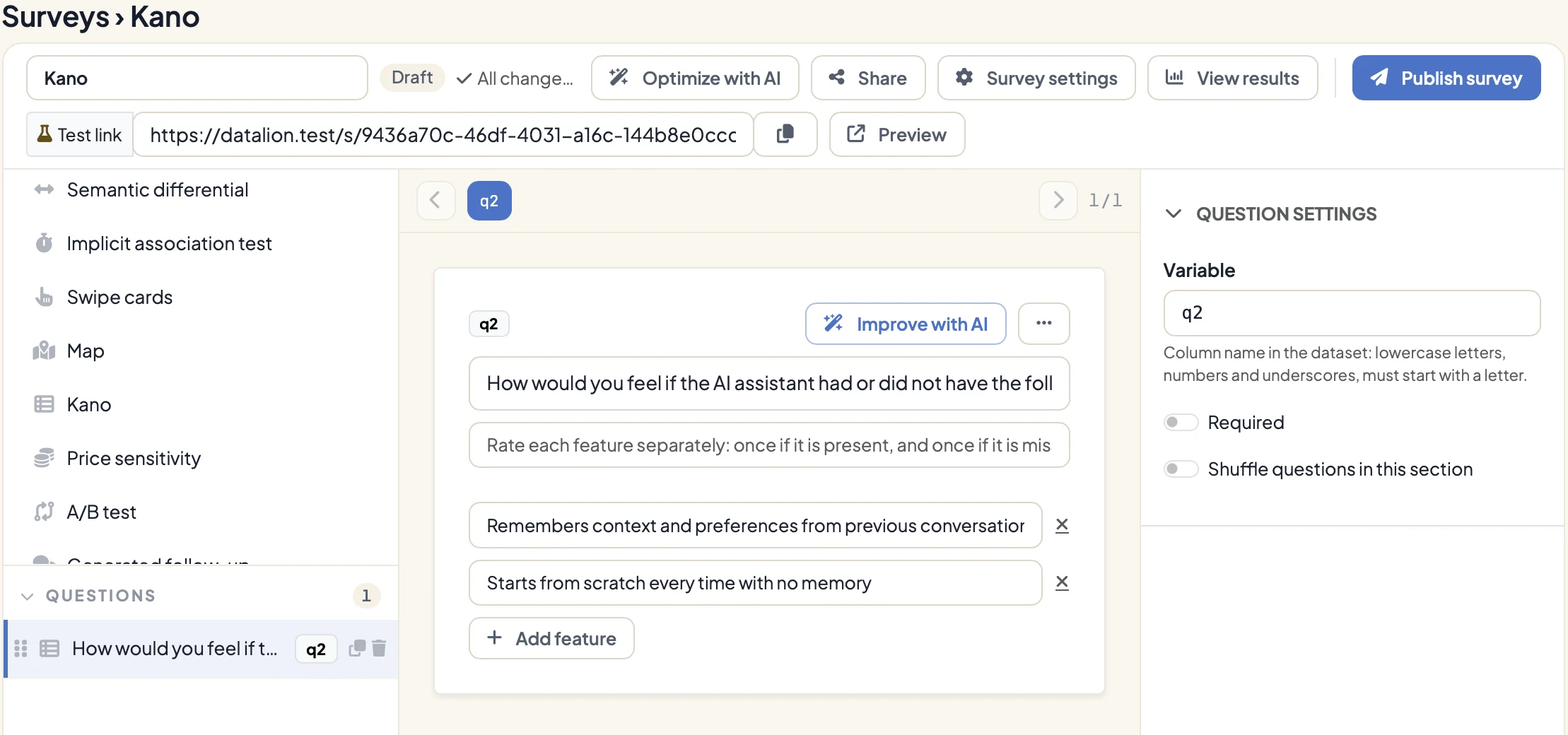
The native Kano question asks about every feature functionally and dysfunctionally: how do people react when it is present, and when it is absent? DataLion derives the Kano category for each feature.
The dataset holds both individual answers plus the classification, such as attractive, one-dimensional, must-be, indifferent, reverse or questionable.
Van Westendorp as a dedicated question type
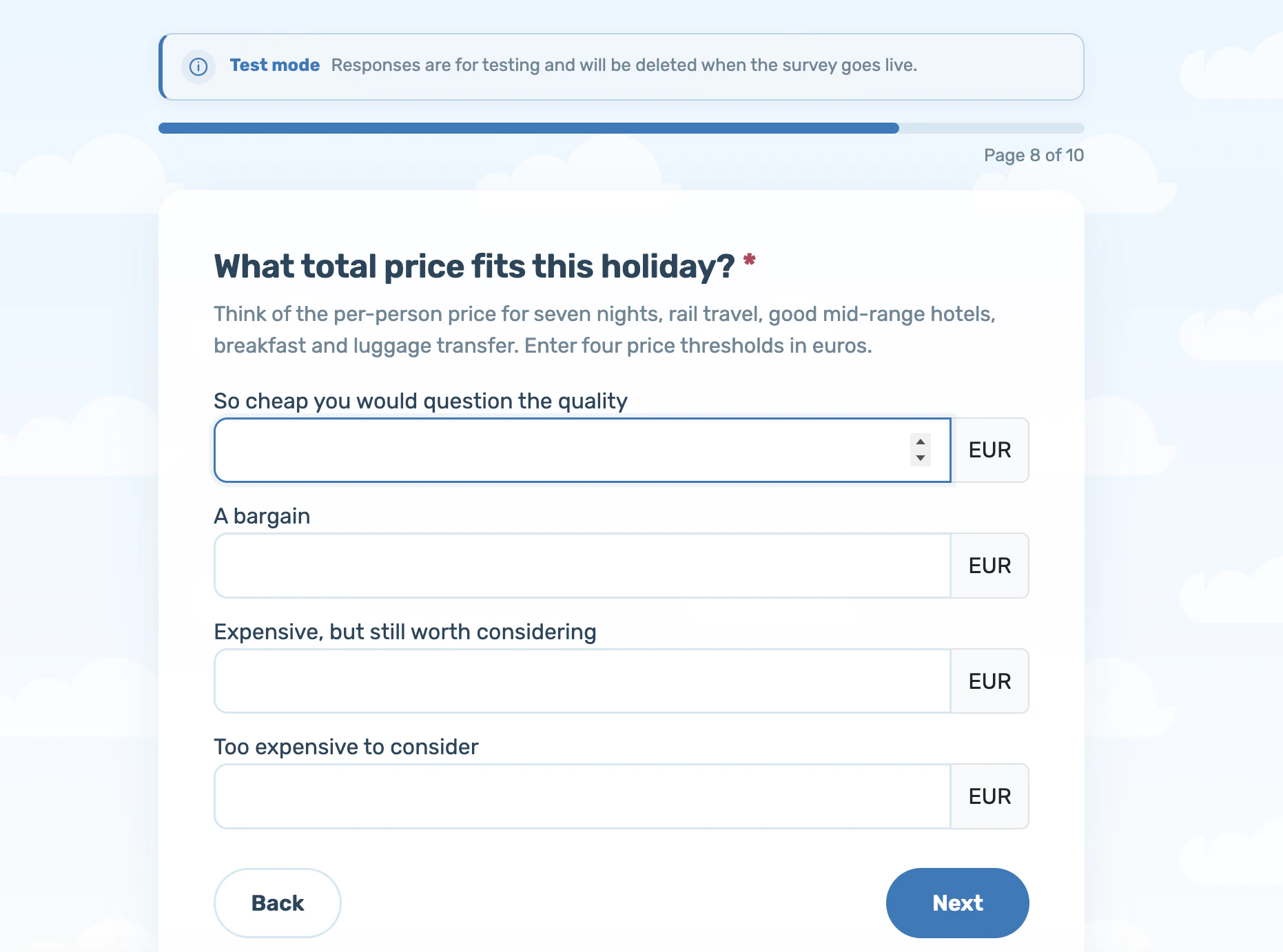
The four Van Westendorp price thresholds are captured in one question: too cheap, cheap, expensive and too expensive. Currency and validation are built into the type.
The four numeric variables are immediately ready for the native PSM chart. The Price Sensitivity Meter page explains the analysis.
A/B testing with stable random assignment
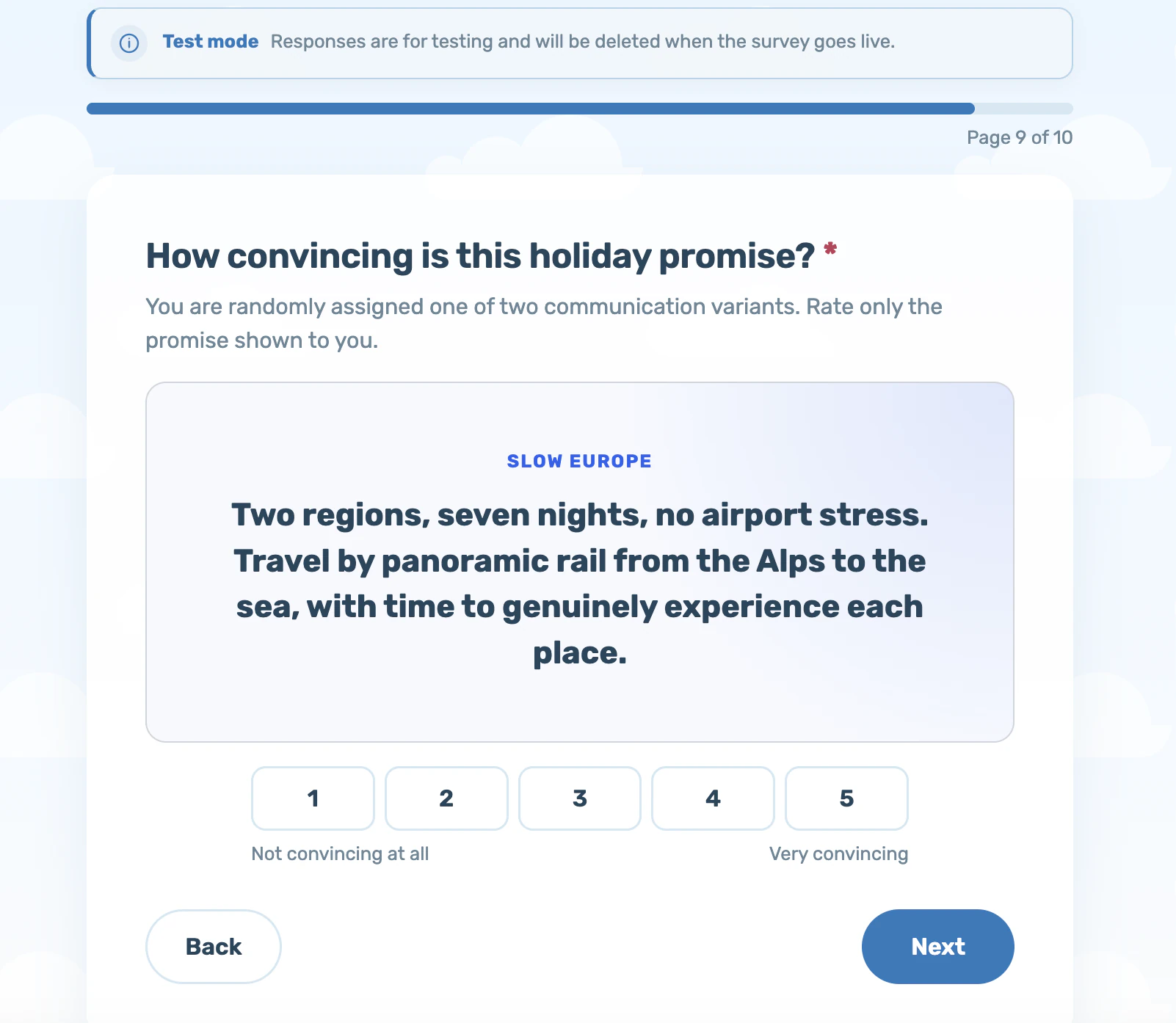
An A/B test shows each person exactly one of up to twelve text or image variants and asks for a rating on a configurable scale. Random assignment is stored when the response starts and stays stable on resume.
Variant and score land separately in the dataset, so you can compare claims, concepts or packshots without manually distributing several questionnaire versions.
AI follow-ups and private file uploads
The generated follow-up connects to an earlier open answer and a research objective. DataLion generates one concise, neutral probe through the configured model endpoint, stores the prompt for reproducible resume behavior and uses the configured fallback if the model fails.
The file upload accepts validated files into private response storage. Allowed extensions, count and size are configurable; downloads are restricted to authorized admins.
See DataLion with your own data
Start free with your own raw data. Or book a personal demo of the path to a finished dashboard.
What users say about DataLion
- via G2
The embedding function allows us to generate insights of our data for our audience and customers by far less than half of the usual time needed before.
Verified user · Leisure, Travel & Tourism - via G2
User-friendliness, especially for market research topics. Structured backend with many customization options.
Verified user · Market Research - via G2
The contacts at DataLion are very committed. If you have problems, you can count on help. DataLion reacts quickly to requests for new functions.
Robert Q. · Managing Director - via G2
Very professional company, attentive to the customer needs, provider of a great software and service.
Generoso M. · CRM Analyst, Automotive

We now work much more efficiently, giving us more time to take care of the derivations and insights from the data for the customers.
More survey features
Guides in the help center
Common questions about question types
Which question types does DataLion survey software support?
Are the new question types prepared for analysis too?
Can DataLion generate a follow-up from an open answer?
Does DataLion support Van Westendorp and Kano natively?
Do A/B tests and IAT remain stable when a survey is resumed?
How are uploaded response files stored?
Try the right question type directly
Start free and build a study with semantic differential, IAT, swipe cards, Kano, PSM or A/B testing. Or book a personal demo.