
Analysis & statistics
Collect and analyze price sensitivity
Collect the four thresholds with a native Van Westendorp question type. DataLion plots the PSM curves and computes the optimal price point and acceptable price range, filterable by segment and with no export.
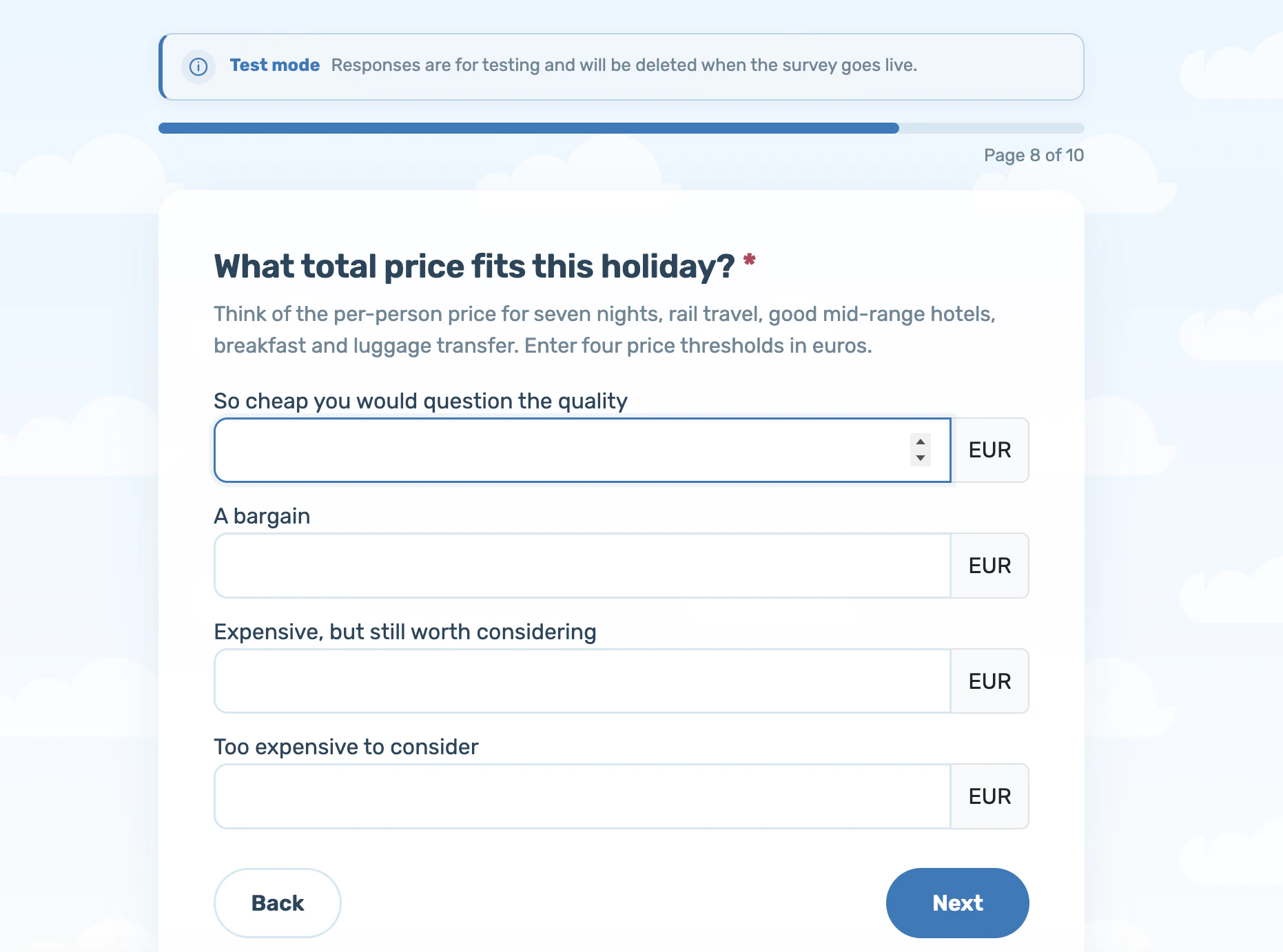
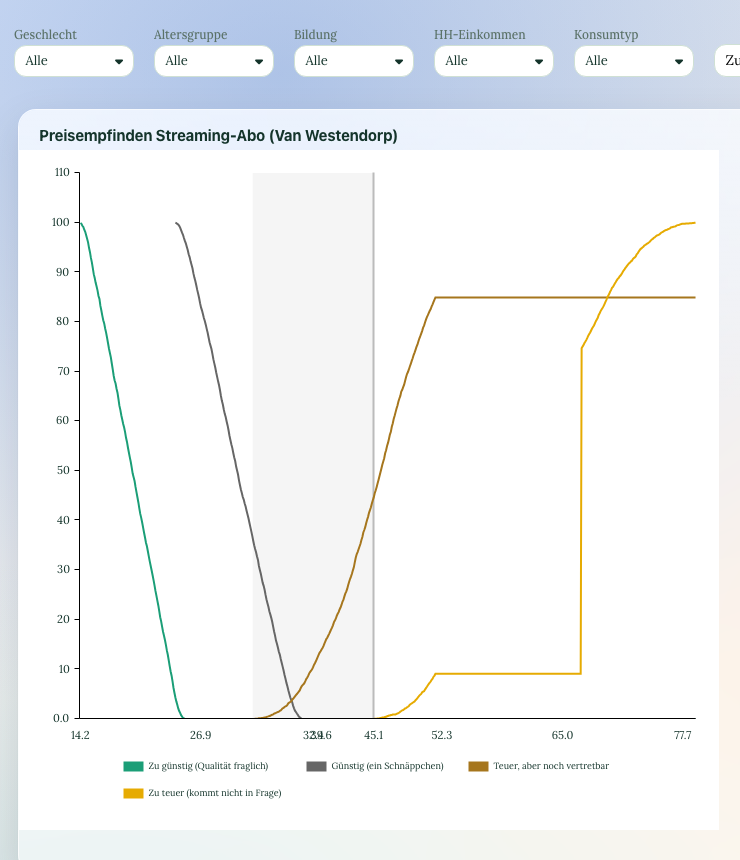
DataLion collects Van Westendorp price sensitivity with a native question type: respondents enter four thresholds for too cheap, cheap, expensive and too expensive. The native PSM chart then plots the cumulative curves and computes the optimal price point (OPP) plus the acceptable range between PMC and PME, directly and filterable by segment.
- 🇩🇪 Made in Munich
- GDPR-compliant
- DPA included
- Hosted in Germany
- 🌐 Interface in EN, DE, FR, ES, IT & NL
Trusted by research institutes, brands & insights teams






- 50+ interactive chart types
- 20+ statistical methods
- SPSS · Excel · CSV import without data loss
- ISO 27001 certified data centers (Germany)
Derive the right price from your audience
The Van Westendorp method does not ask for one price but for four thresholds: at what point is a product too cheap (quality doubts), cheap (a good deal), expensive (getting steep) and too expensive (out of the question)?
The native question type combines all four thresholds with currency and validation on one page. DataLion stores four numeric variables and plots the cumulative curves right in the dashboard.
- Four price questions instead of one point estimate
- One native question type instead of four manually linked inputs
- Willingness to pay without a direct price ask
- Cumulative price curves right in the dashboard
- Established Van Westendorp methodology
Optimal price point and acceptable price range
DataLion computes the key intersections automatically: the optimal price point (OPP) where „too cheap" and „too expensive" cross, plus the acceptable price range between the lower bound (Point of Marginal Cheapness) and the upper bound (Point of Marginal Expensiveness).
At a glance you see the corridor your price should sit in — and which point promises the least buyer resistance.
- Optimal price point (OPP) marked automatically
- Lower bound (Point of Marginal Cheapness)
- Upper bound (Point of Marginal Expensiveness)
- Acceptable price range as a clear corridor
Break it down by segment, wave and market
Because PSM is a native chart type, it runs with your filters and segments: compute price sensitivity for individual audiences, countries or waves and compare where willingness to pay diverges.
The analysis runs directly on your data in the dashboard — with no export to a separate pricing tool, in your own CI and shareable as PowerPoint.
- PSM by segment, country or wave
- Combines with interactive filters
- No separate pricing tool needed
- Shareable as a dashboard and PowerPoint
See DataLion with your own data
Start free with your own raw data. Or book a personal demo of the path to a finished dashboard.
What users say about DataLion
- via G2
The embedding function allows us to generate insights of our data for our audience and customers by far less than half of the usual time needed before.
Verified user · Leisure, Travel & Tourism - via G2
User-friendliness, especially for market research topics. Structured backend with many customization options.
Verified user · Market Research - via G2
The contacts at DataLion are very committed. If you have problems, you can count on help. DataLion reacts quickly to requests for new functions.
Robert Q. · Managing Director - via G2
Very professional company, attentive to the customer needs, provider of a great software and service.
Generoso M. · CRM Analyst, Automotive

We now work much more efficiently, giving us more time to take care of the derivations and insights from the data for the customers.
More analysis features
Common questions about price sensitivity
What price analysis does DataLion offer?
Which metrics does the PSM chart return?
Which questions do I need for a PSM analysis?
Can I analyze price sensitivity by segment?
Find the right price
Try DataLion free and analyze your Van Westendorp price questions directly — optimal price point and price range, with no export. Or book a personal demo.