
Tenant Survey (housing satisfaction)
The full housing-satisfaction survey for cooperatives and housing providers: the home, the neighbourhood, service and community – analysable right down to the individual estate.
The live demo opens the real questionnaire — no signup required.
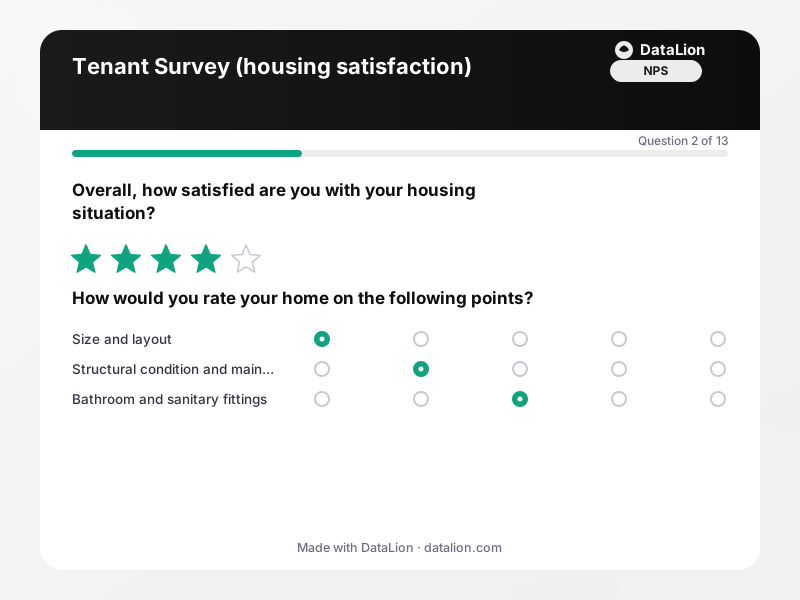
A tenant survey rarely fails on the questionnaire and almost always on the analysis: an overall score of 3.8 helps nobody, because it irons flat the one estate with the maintenance backlog where the dissatisfaction actually sits. This template is therefore built so every block yields its own analysis dimension – home, neighbourhood, service, community – and so the structural questions at the end (length of tenancy, household size, age group) work as filters. Append a parameter per estate to the survey link and the portfolio becomes a comparison dimension in the dashboard too, without you having to ask for it.
When should you use this template?
This template is a great fit for:
- As the major housing-satisfaction survey on a two- to three-year cycle
- As a baseline before a neighbourhood or modernisation programme
- Via QR code on the cover letter, in the stairwell or in the tenant portal
- As the basis for reporting to the supervisory board and members' meeting
Every question in this template
- 1Rating
Overall, how satisfied are you with your housing situation? *
- 2Matrix
How would you rate your home on the following points?
Very poor Poor Average Good Very good Size and layout Structural condition and maintenance Bathroom and sanitary fittings Heating and hot water Sound insulation - 3Matrix
And how would you rate your neighbourhood?
Very poor Poor Average Good Very good Cleanliness of building and stairwell Outdoor areas and green spaces Play and leisure areas Parking situation Bin store and waste disposal - 4Matrix
How satisfied are you with our service?
Very dissatisfied Dissatisfied Neither Satisfied Very satisfied Reachability of your contact person Friendliness and helpfulness Time taken to handle requests Quality of contractor work Clarity of letters and statements - 5Rating
How do you rate your rent and service charges against what you get for them?
- 6Single choice
How do you experience community life in your neighbourhood?
- Very good – people help each other
- Good – friendly but distant
- Neutral – we barely know each other
- Rather difficult – conflicts happen regularly
- Poor – there are persistent problems
- 7NPS (0–10)
How likely are you to recommend us as a landlord? *
- 8Multiple choice
Where should we invest first, in your view? (Please choose no more than three)
- Modernising the flats
- Energy retrofit and heating
- Stairwell and building cleaning
- Outdoor areas, greenery and playgrounds
- Car and bicycle parking
- Faster handling of repairs
- 9Long text
What should we improve first on your estate?
Please write freely – the more concrete, the better.
- 10Single choice
How long have you been living with us?
- Less than 2 years
- 2 to 5 years
- 6 to 15 years
- 16 to 30 years
- More than 30 years
- 11Single choice
How many people live in your household?
- 1 person
- 2 people
- 3 to 4 people
- 5 or more people
- 12Single choice
Which age group do you belong to?
- Under 30
- 30 to 44
- 45 to 59
- 60 to 74
- 75 and over
- Prefer not to say
- 13Single choice
How would you prefer us to keep you informed?
- Letter or notice board
- Tenant portal or app
- Telephone
- In person at the office
From questionnaire to dashboard
The questionnaire produces a dashboard the housing sector can actually steer with:
- Estates compared: The crosstab of rating aspects against estate as a heatmap: red cells show immediately which estate slips on which topic – instead of an overall mean that triggers nothing.
- Diverging profile of the rating blocks: The matrix questions on home, neighbourhood and service as split bars: satisfied shares to the right, dissatisfied to the left – the fastest read on the ranking of problem areas.
- Recommendation (NPS question): The 0–10 distribution separates committed members from critics; filtered by length of tenancy it shows whether loyalty grows or erodes over the years.
- Open answers by topic and sentiment: AI coding turns free text into two new variables – topic and sentiment. That turns "nobody reads this anyway" into an ordinary analysis, cross-tabulatable by estate and length of tenancy.
Related survey templates
- Restaurant Guest FeedbackShort, anonymous feedback on food, service and ambience – via QR code on the table, the bill or the menu.
- System Usability Scale (SUS)The standard usability questionnaire: 10 statements, one score from 0 to 100 – comparable with thousands of studies. Includes the established German translation.
- Beta Test FeedbackStructured feedback from beta testers: usage depth, stability, missing features and the disappointment question as an early product-market-fit indicator.
- Campsite Guest Survey (post-stay)After departure, collect feedback on pitches, sanitary facilities, team and activities – via QR code at reception, at the barrier or in your departure email.
Frequently asked questions
How do we analyse results per estate without giving up anonymity?
Many of our members prefer to answer on paper. Is that possible?
How do we make sure each household answers only once?
What do we do with all the open-text answers?
Start with this template
Load the template into DataLion, adapt it to your brand and start collecting responses — GDPR-compliant, in minutes.