
Employee performance review
A structured appraisal form for the annual review: performance, collaboration, development and goal setting — with self and manager assessment.
The live demo opens the real questionnaire — no signup required.
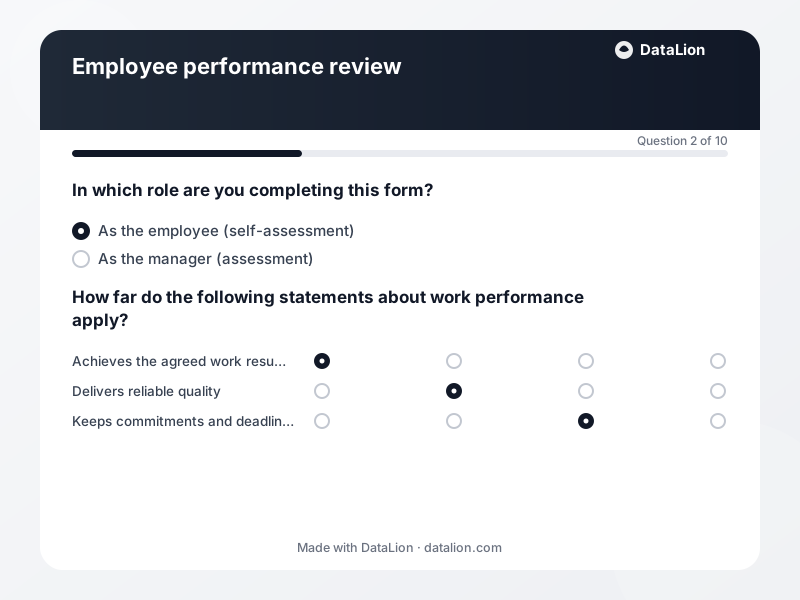
Appraisal forms rarely fail for lack of questions; they fail for vague ones. "Commitment: 1 to 5" mostly measures how well disposed the assessor happens to feel. This template therefore uses behaviour-based statements rather than trait judgements: not "is reliable" but "keeps commitments and deadlines". That can be observed, evidenced and discussed. It is completed twice — by the manager and by the employee — and the gaps between the two forms are exactly what the conversation is for.
When should you use this template?
This template is a great fit for:
- You hold annual or half-yearly reviews and want them to be comparable
- Existing forms produce ratings that are not comparable between managers
- You want to contrast self and manager assessment rather than merely rate
- Development goals should be documented and reviewable the following year
- You are preparing to introduce 360-degree feedback and need a solid base appraisal first
Every question in this template
- 1Single choice
In which role are you completing this form? *
- As the employee (self-assessment)
- As the manager (assessment)
- 2Matrix
How far do the following statements about work performance apply? *
Please refer to the past review period.
Rarely applies Partly applies Mostly applies Consistently applies Achieves the agreed work results Delivers reliable quality Keeps commitments and deadlines Works in a structured way even under pressure Spots problems early and raises them - 3Matrix
How far do the following statements about collaboration apply? *
Rarely applies Partly applies Mostly applies Consistently applies Shares knowledge and information within the team Gives feedback factually and in good time Accepts criticism and works with it Supports colleagues when things get tight Takes on tasks beyond their own role - 4Matrix
How far do the following statements about expertise and autonomy apply?
Rarely applies Partly applies Mostly applies Consistently applies Has the expertise required for the tasks Gets to grips with new topics independently Makes decisions within their own remit Implements improvements on their own initiative - 5Single choice
How were the goals of the past review period met?
- Not met
- Partly met
- Fully met
- Exceeded
- No goals had been agreed
- 6Long text
What went particularly well in the past period?
Please anchor this in concrete situations where possible.
- 7Long text
Where were there difficulties, and what caused them?
External conditions may be named here too, not only personal points.
- 8Long text
Which development goals should apply for the next period?
Phrase them so they can be checked — the next review will refer back to them.
- 9Long text
What support is needed for that?
For example training, time, tools or changed responsibilities.
- 10Long text
Is there anything else that should come up in the meeting?
Related survey templates
- Psychosocial Risk Assessment (Workplace)Anonymous employee survey to fulfil the psychosocial risk assessment required under the German Occupational Safety Act (§5 ArbSchG), along the recognised GDA assessment areas.
- AI Literacy Assessment (EU AI Act Art. 4)Anonymous self-assessment of your employees' AI literacy – as a needs analysis and documentation basis for the training obligation under Article 4 of the EU AI Act.
- Psychological Safety in TeamsMeasures, following Amy Edmondson, whether team members can take risks, admit mistakes and voice concerns – the strongest known predictor of team performance.
- Recovery Experience (REQ)Four ways of refuelling after work: detachment, relaxation, mastery and control – shown as a profile across all four dimensions.
Frequently asked questions
Who completes the form — manager or employee?
Why behaviour-based statements instead of traits?
Can appraisals be collected anonymously?
What requires works council involvement?
How do I avoid everyone ticking the middle?
How do we analyse this across many employees?
Start with this template
Load the template into DataLion, adapt it to your brand and start collecting responses — GDPR-compliant, in minutes.