
Psychological Safety in Teams
Measures, following Amy Edmondson, whether team members can take risks, admit mistakes and voice concerns – the strongest known predictor of team performance.
The live demo opens the real questionnaire — no signup required.
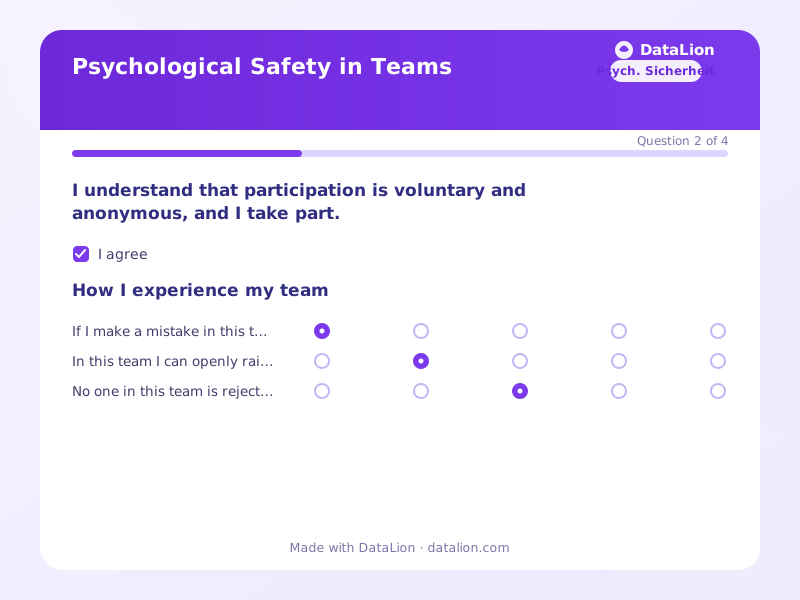
Psychological safety – the shared belief that no one is punished for questions, mistakes or dissent – has been the best-evidenced team success factor since Amy Edmondson's research at Harvard Business School and Google's Project Aristotle. This template turns Edmondson's seven classic dimensions into a short, anonymous team survey and adds a behavioural check: how often do employees actually hold back ideas or concerns? Because the real insight often sits between “one could speak up here” and “I actually do”. The results belong to the team: discuss them together, never file them away.
When should you use this template?
This template is a great fit for:
- As a team diagnostic before retrospectives or team workshops
- After restructurings, leadership changes or conflicts
- As a semi-annual pulse alongside eNPS and employee satisfaction
Every question in this template
- 1Consent
I understand that participation is voluntary and anonymous, and I take part. *
- 2Matrix
How I experience my team *
Please rate the following statements for the team you mainly work in.
Strongly disagree Disagree Neutral Agree Strongly agree If I make a mistake in this team, it is not held against me. In this team I can openly raise problems and tough issues. No one in this team is rejected for being different. It is safe to take a risk in this team. It is easy for me to ask other team members for help. - 3Single choice
How often do you hold back ideas, questions or concerns even though they would be relevant? *
- Never
- Rarely
- Sometimes
- Often
- Very often
- 4Long text
What would make it easier for you to speak openly in the team?
From questionnaire to dashboard
In the dashboard the answers become a team climate profile you can compare across teams and waves:
- Safety index: The mean across all seven dimensions as a gauge – the metric for before/after comparisons of team interventions.
- Profile of the seven dimensions: Diverging bars per statement show whether the issue lies in handling mistakes, exclusion or asking for help.
- Team comparison: Means per team (given sufficient group size) show where leaders need support – and whom they can learn from.
- Silence indicator: The behavioural question “how often do you hold back ideas?” as a stacked bar – the most honest single figure in the survey.
- What would make speaking up easier: The open question, clustered via AI topic analysis – concrete starting points for the team retrospective.
Related survey templates
- Psychosocial Risk Assessment (Workplace)Anonymous employee survey to fulfil the psychosocial risk assessment required under the German Occupational Safety Act (§5 ArbSchG), along the recognised GDA assessment areas.
- AI Literacy Assessment (EU AI Act Art. 4)Anonymous self-assessment of your employees' AI literacy – as a needs analysis and documentation basis for the training obligation under Article 4 of the EU AI Act.
- Recovery Experience (REQ)Four ways of refuelling after work: detachment, relaxation, mastery and control – shown as a profile across all four dimensions.
- 360-Degree FeedbackGather structured feedback from every perspective – from managers, peers and direct reports as well as self-assessment.
Frequently asked questions
What is the questionnaire based on?
From what team size can we analyse results?
What to do with a low score?
Start with this template
Load the template into DataLion, adapt it to your brand and start collecting responses — GDPR-compliant, in minutes.