
AI Literacy Assessment (EU AI Act Art. 4)
Anonymous self-assessment of your employees' AI literacy – as a needs analysis and documentation basis for the training obligation under Article 4 of the EU AI Act.
The live demo opens the real questionnaire — no signup required.
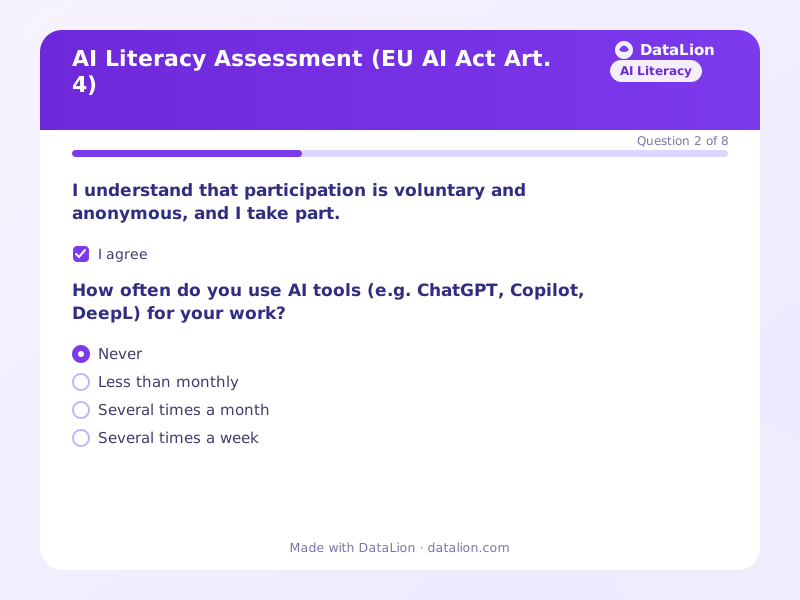
Since 2 February 2025, Article 4 of the EU AI Act obliges organisations deploying AI to ensure a sufficient level of AI literacy among their staff. The first step is an honest baseline: who uses AI how often, how confident are teams in applying and evaluating it and in handling its risks – and where is training most urgent? This template draws on established AI literacy scales such as the Meta AI Literacy Scale (MAILS, University of Würzburg) and covers three competence areas: applying & using, understanding & evaluating, and ethics & risks. The results double as a documented needs analysis for your AI Act compliance file.
When should you use this template?
This template is a great fit for:
- As a needs analysis and documentation basis for the AI literacy obligation under Article 4 of the EU AI Act
- Before and after AI training to make learning progress measurable
- As a baseline per department when rolling out AI tools
Every question in this template
- 1Consent
I understand that participation is voluntary and anonymous, and I take part. *
- 2Single choice
How often do you use AI tools (e.g. ChatGPT, Copilot, DeepL) for your work? *
- Never
- Less than monthly
- Several times a month
- Several times a week
- Daily
- 3Matrix
Applying & using *
How much do the following statements apply to you?
Strongly disagree Disagree Neutral Agree Strongly agree I can confidently use common AI tools for my tasks. I can phrase prompts so that I get useful results. I know which tasks in my daily work AI is well suited for – and which not. I can integrate AI output into my workflows in a meaningful way. - 4Matrix
Understanding & evaluating *
Strongly disagree Disagree Neutral Agree Strongly agree I understand in broad terms how generative AI produces its answers. I can judge how reliable an AI result is. I recognise typical AI errors, e.g. fabricated facts (hallucinations). I verify AI output before using it further. - 5Matrix
Ethics & risks *
Strongly disagree Disagree Neutral Agree Strongly agree I know which data I may enter into AI tools – and which not. I know our organisation's internal rules on AI use. I pay attention to copyright and confidentiality when working with AI. I am aware that AI output can contain bias. - 6Single choice
Overall, how would you rate your AI literacy?
- Beginner – I have hardly used AI so far
- Basic – I occasionally use AI for simple tasks
- Advanced – AI is a regular part of how I work
- Expert – I also help others use AI
- 7Multiple choice
On which topics would you like training or support?
Multiple answers possible.
- Basics: how does generative AI work?
- Better prompting: phrasing effective requests
- Data protection, copyright and the EU AI Act
- AI tools for my specific area of work
- Verifying and evaluating AI output
- No training needed
- 8Long text
Where could AI take the most work off your plate?
From questionnaire to dashboard
Each question automatically becomes a variable in your DataLion dataset. From it you build a competence dashboard you can filter by department, location or wave:
- AI literacy index: The mean across all competence statements as a KPI tile – your headline figure for AI Act reporting and before/after training comparisons.
- Profile of the three competence areas: Mean-value bars for applying, understanding and ethics & risks show at a glance which area needs training first.
- Agreement profile per statement: Diverging bars show agreement versus disagreement for every single statement – ideal for spotting concrete knowledge gaps.
- Competence heatmap by department: Cross competence areas with departments: the heatmap shows where targeted training is needed instead of one-size-fits-all courses.
- Requested training topics: The multiple-choice training wishes as a donut or bar chart – this becomes your training plan.
- AI topic analysis of open answers: Analyse the open question on use-case ideas with DataLion's AI topic and sentiment analysis – as a word cloud or topic list.
Related survey templates
- Psychosocial Risk Assessment (Workplace)Anonymous employee survey to fulfil the psychosocial risk assessment required under the German Occupational Safety Act (§5 ArbSchG), along the recognised GDA assessment areas.
- Psychological Safety in TeamsMeasures, following Amy Edmondson, whether team members can take risks, admit mistakes and voice concerns – the strongest known predictor of team performance.
- Recovery Experience (REQ)Four ways of refuelling after work: detachment, relaxation, mastery and control – shown as a profile across all four dimensions.
- 360-Degree FeedbackGather structured feedback from every perspective – from managers, peers and direct reports as well as self-assessment.
Frequently asked questions
What exactly does Article 4 of the EU AI Act require?
Is the questionnaire based on a validated instrument?
Should the survey be anonymous?
Start with this template
Load the template into DataLion, adapt it to your brand and start collecting responses — GDPR-compliant, in minutes.