
CSRD Double Materiality Assessment (Stakeholder Survey)
Stakeholders rate the ESRS topic areas by impact and financial materiality – the data basis for your CSRD materiality matrix.
The live demo opens the real questionnaire — no signup required.
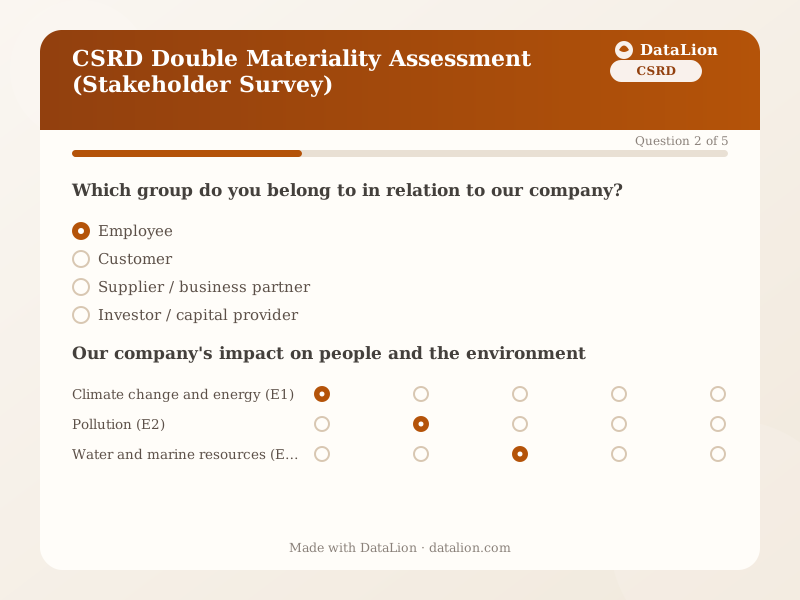
The EU Corporate Sustainability Reporting Directive (CSRD) requires in-scope companies to run a double materiality assessment: for every sustainability topic, evaluate how strongly the company affects people and the environment (inside-out, impact materiality) and how strongly the topic financially affects the company (outside-in, financial materiality). Stakeholder involvement is explicitly foreseen – and that is exactly what this template delivers: employees, customers, suppliers, investors and other groups rate the topic areas of the European Sustainability Reporting Standards (ESRS) on both dimensions. The result is the data basis for your materiality matrix and documented stakeholder engagement for the auditor.
When should you use this template?
This template is a great fit for:
- At the start of every CSRD materiality assessment as structured stakeholder engagement
- For the annual review of the materiality matrix
- Also for voluntary reporters (e.g. under VSME) as a lean entry point
Every question in this template
- 1Single choice
Which group do you belong to in relation to our company? *
- Employee
- Customer
- Supplier / business partner
- Investor / capital provider
- Municipality, NGO or association
- Other
- 2Matrix
Our company's impact on people and the environment
How significant is our company's impact on the following topics – positive or negative? (Inside-out perspective)
Not significant Low significance Medium significance High significance Very high significance Climate change and energy (E1) Pollution (E2) Water and marine resources (E3) Biodiversity and ecosystems (E4) Resource use and circular economy (E5) - 3Matrix
Financial significance of the topics for our company
How strongly do the following topics affect our company financially, as risks or opportunities? (Outside-in perspective)
Not significant Low significance Medium significance High significance Very high significance Climate change and energy (E1) Pollution (E2) Water and marine resources (E3) Biodiversity and ecosystems (E4) Resource use and circular economy (E5) - 4Ranking
Which topics should our company address with the highest priority?
Please rank the topics – the most important first.
- 1Climate action and energy
- 2Circular economy and resources
- 3Fair working conditions
- 4Supply chain responsibility
- 5Consumer protection and data security
- 6Ethics and good governance
- 5Long text
What concrete expectations do you have of our company on sustainability?
From questionnaire to dashboard
The dashboard builds the exact visuals your sustainability report needs from the ratings:
- Materiality matrix: The centrepiece: per ESRS topic, mean impact materiality plotted against financial materiality as a scatter chart – topics in the top right are double material and therefore reportable.
- Stakeholder comparison: Topics crossed with stakeholder groups as a heatmap: do investors rate climate change differently from your own workforce? Exactly these differences are what the assessment requires.
- Topic profiles per dimension: Mean bars per topic, separated into inside-out and outside-in – the tabular complement to the matrix for the report annex.
- Priority ranking: The ranking question shows which topics stakeholders put on top – a plausibility check for your threshold decision.
- Expectations verbatim: Open-ended expectations as a searchable text list plus AI topic analysis – quotes from it bring the stakeholder engagement section of your report to life.
Related survey templates
- General FeedbackCollect quick and simple general feedback on your company, product or service – including an overall rating and recommendation.
- Big Five Personality Self-AssessmentA compact IPIP-based self-assessment of extraversion, agreeableness, conscientiousness, emotional sensitivity and openness – with a personal radar profile.
- Data & Analytics MaturityWhere does your organisation stand between spreadsheet islands and data-driven decisions? Five areas, a maturity profile and an instant report.
- Data Culture Compass: Where Does Your Organisation Stand?Two axes, sixteen statements: how easily do your people reach data, and how often do decisions rest on it? The result is a field in a four-field matrix.
Frequently asked questions
Is this survey sufficient as a materiality assessment?
Which stakeholders should we survey?
Can we adapt the topic list?
Does the CSRD even apply to us?
Start with this template
Load the template into DataLion, adapt it to your brand and start collecting responses — GDPR-compliant, in minutes.