
Customer Acceptance of AI Features
Before launching AI features, measure where your customers accept AI, where they prefer humans – and what builds trust.
The live demo opens the real questionnaire — no signup required.
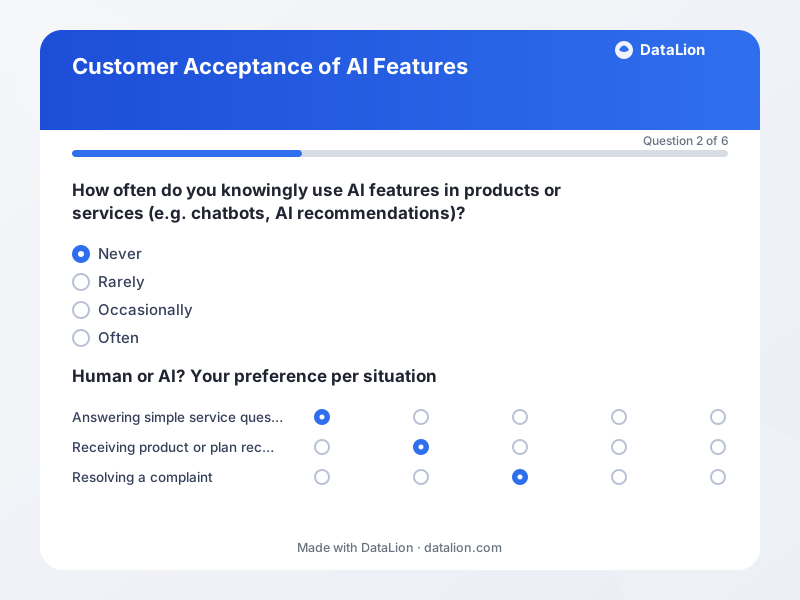
Many companies are building AI into their products right now – and only learn after launch where customers welcome it and where it costs trust. This template reverses the order. Its centrepiece is a scenario matrix: for typical situations (service requests, recommendations, advice, decisions) respondents state whether they would rather be served by a human, an AI or a combination. Trust statements and labelling expectations follow – relevant also in view of the transparency obligations of the EU AI Act. Simply adapt the scenarios to your industry.
When should you use this template?
This template is a great fit for:
- Before launching AI features as an acceptance baseline
- To prioritise which processes get AI support first
- As a repeat measurement to track how trust develops
Every question in this template
- 1Single choice
How often do you knowingly use AI features in products or services (e.g. chatbots, AI recommendations)? *
- Never
- Rarely
- Occasionally
- Often
- Daily
- 2Matrix
Human or AI? Your preference per situation
Who would you like to be served by in the following situations?
Human only Rather human No preference, as long as it works Rather AI Happy with AI Answering simple service questions (e.g. delivery status) Receiving product or plan recommendations Resolving a complaint Personal advice on an important decision Deciding on my application or request - 3Matrix
Trust in AI
How much do you agree with the following statements?
Strongly disagree Disagree Neutral Agree Strongly agree I trust companies to use AI responsibly. AI answers are usually helpful for me. I am fine with AI using my data to personalise offers. For important matters I always want to be able to reach a human. - 4Single choice
How important is it to you that AI features are clearly labelled as such?
- Very important – I always want to know
- Somewhat important
- Not very important
- Irrelevant, as long as the result is good
- 5Rating
Overall, how comfortable are you with AI features in the products you use?
- 6Long text
What would strengthen your trust in AI features the most?
From questionnaire to dashboard
The dashboard shows at a glance where your customers accept AI – and where human contact is (still) indispensable:
- Human-vs-AI profile per scenario: The scenario matrix as 100% stacked bars: for each situation you see the share from “human only” to “happy with AI” – your prioritisation map for AI features.
- Trust profile: The trust statements as diverging bars show whether scepticism is driven by data use, quality or lack of transparency.
- Comfort index by segment: The comfort rating as a mean, crossed with age or customer group – AI acceptance often differs sharply between segments.
- Transparency expectation: How many customers expect clear AI labelling? The donut delivers the argument for your product and legal teams.
- Trust drivers from open answers: The open question on what would build trust, analysed with AI topic and sentiment analysis.
Related survey templates
- Restaurant Guest FeedbackShort, anonymous feedback on food, service and ambience – via QR code on the table, the bill or the menu.
- System Usability Scale (SUS)The standard usability questionnaire: 10 statements, one score from 0 to 100 – comparable with thousands of studies. Includes the established German translation.
- Beta Test FeedbackStructured feedback from beta testers: usage depth, stability, missing features and the disappointment question as an early product-market-fit indicator.
- Campsite Guest Survey (post-stay)After departure, collect feedback on pitches, sanitary facilities, team and activities – via QR code at reception, at the barrier or in your departure email.
Frequently asked questions
Why measure acceptance before launch?
Do I need to adapt the scenarios?
What is the labelling question about?
Start with this template
Load the template into DataLion, adapt it to your brand and start collecting responses — GDPR-compliant, in minutes.