
AI in the Classroom (Teacher Survey)
Captures usage, opportunities, risks and training needs around AI at schools or universities – as a basis for guidelines and professional development planning.
The live demo opens the real questionnaire — no signup required.
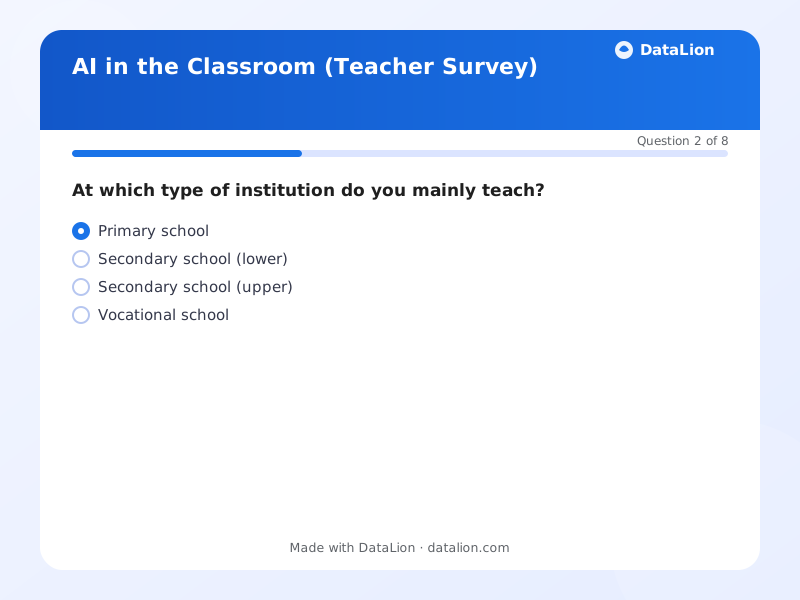
Few topics move schools and universities as much as generative AI right now: some use it to prepare lessons, others worry about assessment and data protection – and many faculties lack a common position. This template gives school leadership, departments and academic developers an honest picture: who uses AI for what, where do educators see opportunities for individual support and workload relief, where risks for assessment and original work, and what training is needed? The survey is anonymous and can be adapted for students or parents with minimal changes.
When should you use this template?
This template is a great fit for:
- Before drafting AI guidelines for a school or university
- To plan professional development along actual needs
- As an annual repeat to track how the faculty evolves
Every question in this template
- 1Single choice
At which type of institution do you mainly teach? *
- Primary school
- Secondary school (lower)
- Secondary school (upper)
- Vocational school
- University / higher education
- 2Single choice
How often do you use AI tools (e.g. ChatGPT) for your teaching? *
- Never
- Rarely
- Monthly
- Weekly
- (Almost) daily
- 3Multiple choice
What do you already use AI for?
Multiple answers possible.
- Preparing lessons or courses
- Creating materials and tasks
- Differentiation and support material
- Feedback on texts and marking
- My own professional learning
- Not at all
- 4Matrix
Opportunities of AI in teaching
How much do you agree with the following statements?
Strongly disagree Disagree Neutral Agree Strongly agree AI helps me support learners more individually. AI noticeably relieves me of routine tasks. Reflective use of AI is part of media literacy today. - 5Matrix
Risks of AI in teaching
How much do you agree with the following statements?
Strongly disagree Disagree Neutral Agree Strongly agree Learners submit AI-written texts as their own work. Fair assessment becomes harder because of AI. Data protection around AI use is unresolved. Learners lose basic skills. - 6Single choice
Does your institution have binding rules on AI use?
- Yes, clear rules
- In progress
- No
- I don't know
- 7Single choice
How big is your personal training need on AI?
- No need
- Low
- Medium
- High
- Very high
- 8Long text
What support on AI would you like from your leadership?
From questionnaire to dashboard
The dashboard shows where your faculty stands on AI – and what to do first:
- Usage & purposes: Usage frequency and purposes as bar charts – from drafting worksheets to giving feedback on texts.
- Opportunities vs. risks: Both matrix blocks contrasted as diverging bars: does your faculty see AI more as relief or as a threat to assessment practice?
- Clarity of rules: The donut on binding rules shows how urgently a common guideline is needed.
- Training needs by school type or subject: Training needs crossed with school type or department as a heatmap – so you plan offers where they are needed.
- Requests to leadership: The open question on desired support, clustered via AI topic analysis – the agenda for your next staff meeting.
Related survey templates
- Parent Survey (Daycare / School)Find out how satisfied parents are with the communication, care and facilities of your daycare or school – and where you can take action.
- Alumni SurveyFind out where your graduates are today and how relevant their studies were to their career path.
- Career Orientation Test: Interests, Work Values and StrengthsThree parts like the big career tests: 60 activities based on the Holland model, 18 work values and 12 key qualifications. At the end an interest code, a values profile and a PDF for the counselling session.
- Instructor EvaluationEvaluate the teaching qualities of your instructors anonymously – from clarity and fairness to availability.
Frequently asked questions
Can we use the template for students as well?
How do we ensure anonymity in a faculty?
Does the template reflect German state-level guidelines?
Start with this template
Load the template into DataLion, adapt it to your brand and start collecting responses — GDPR-compliant, in minutes.