
Training needs analysis
Needs analysis ahead of training planning: where are competencies missing, which topics are urgent, and which formats fit into the working day?
The live demo opens the real questionnaire — no signup required.
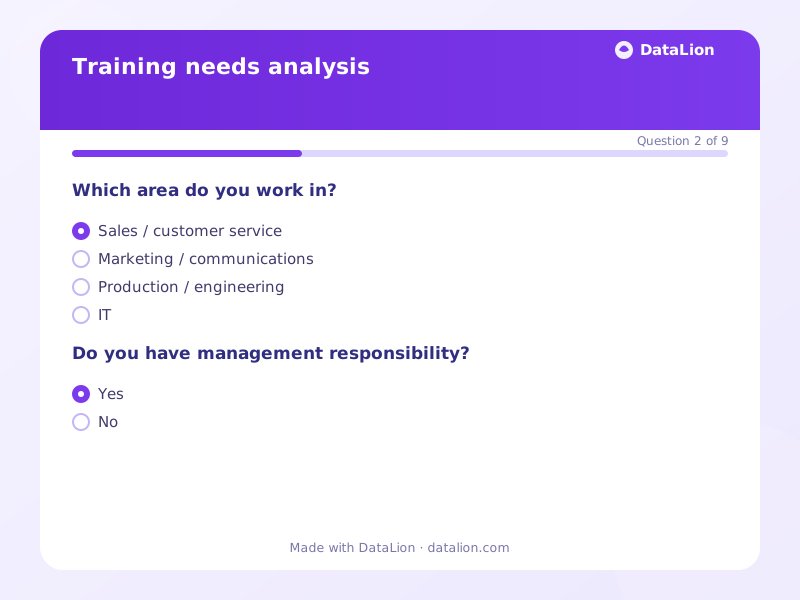
Training budgets rarely fail because the courses are bad; they fail because they miss the need. This template captures the need before planning starts: where is there a gap between what the job requires and what is there? Which topics are not merely desirable but urgent? And which formats can actually be fitted into the working day — the best seminar is useless if nobody can take two consecutive days off. The prioritisation question forces a ranking rather than a wish list on which everything is important.
When should you use this template?
This template is a great fit for:
- You are planning next year's training budget and want to justify it
- Existing offerings are poorly taken up and you do not know why
- New tools or processes were introduced and the qualification level is unclear
- You want to compare needs across departments rather than collect them one by one
- Ahead of a tender to training providers, to describe the need precisely
Every question in this template
- 1Single choice
Which area do you work in?
Used only for analysis by area.
- Sales / customer service
- Marketing / communications
- Production / engineering
- IT
- Administration / finance / HR
- Other
- 2Single choice
Do you have management responsibility?
- Yes
- No
- 3Matrix
How well equipped do you feel in these areas for your tasks? *
This is about the gap between what the job requires and what is there.
Clear gap Noticeable gap Largely sufficient Fully sufficient Technical knowledge for my core tasks Digital tools and software in daily work Working with data and analysis AI tools in daily work Communication and conversation skills - 4Ranking
Which topics are most urgent for your work?
Please put these in order — the most important topic first.
- 1Deeper expertise in my own field
- 2Digital tools and software
- 3Data analysis and reporting
- 4AI in daily work
- 5Communication and conflict resolution
- 6Leadership and collaboration
- 5Multiple choice
Which formats fit into your working day?
Multiple answers possible.
- Half-day in-person workshop
- Multi-day seminar
- Live online session (1–2 hours)
- Self-paced course, freely schedulable
- Short learning units of 10–15 minutes
- Mentoring by experienced colleagues
- 6Multiple choice
What has kept you from using training offerings so far?
Multiple answers possible.
- No time alongside day-to-day work
- Offerings did not fit in content
- I did not know what was on offer
- Dates were inconvenient
- Travel too burdensome
- Unclear whether my area covers the budget
- 7Single choice
How much time could you realistically spend on training per quarter?
- Less than half a day
- About half a day
- One to two days
- More than two days
- 8Long text
Which specific topic would help you most in your work?
The more specific, the easier it is to find a suitable offering.
- 9Long text
Is there knowledge in the team that should be passed on?
Sometimes the answer is in-house — you can point to it here.
Related survey templates
- Psychosocial Risk Assessment (Workplace)Anonymous employee survey to fulfil the psychosocial risk assessment required under the German Occupational Safety Act (§5 ArbSchG), along the recognised GDA assessment areas.
- AI Literacy Assessment (EU AI Act Art. 4)Anonymous self-assessment of your employees' AI literacy – as a needs analysis and documentation basis for the training obligation under Article 4 of the EU AI Act.
- Psychological Safety in TeamsMeasures, following Amy Edmondson, whether team members can take risks, admit mistakes and voice concerns – the strongest known predictor of team performance.
- Recovery Experience (REQ)Four ways of refuelling after work: detachment, relaxation, mastery and control – shown as a profile across all four dimensions.
Frequently asked questions
Should the survey be anonymous?
How does this differ from a performance appraisal?
Why a prioritisation question instead of simply asking about everything?
How often should needs be surveyed?
What do I do with the results?
Start with this template
Load the template into DataLion, adapt it to your brand and start collecting responses — GDPR-compliant, in minutes.