
Audience Segmentation
Divide your market into clearly distinguishable segments – based on the attitudes, behaviour and demographics of your audience.
The live demo opens the real questionnaire — no signup required.
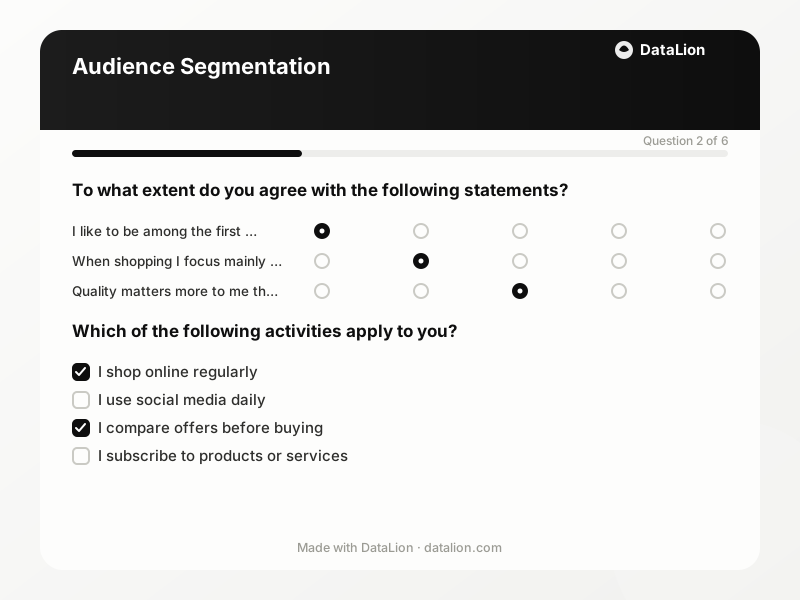
This template provides the building blocks for a robust segmentation: an attitude matrix captures values and stances, a behaviour question records actual usage, and several demographic questions describe the structure of your audience. Combining them lets you form distinct segments that you can address in a targeted way.
When should you use this template?
This template is a great fit for:
- To build a data-driven segmentation
- Before developing personas and audience messaging
- To sharpen product, communication and sales strategy
Every question in this template
- 1Matrix
To what extent do you agree with the following statements?
Strongly disagree Somewhat disagree Neither agree nor disagree Somewhat agree Strongly agree I like to be among the first to try new products When shopping I focus mainly on the price Quality matters more to me than price Sustainability influences my purchase decisions I research thoroughly before I buy something - 2Multiple choice
Which of the following activities apply to you?
- I shop online regularly
- I use social media daily
- I compare offers before buying
- I subscribe to products or services
- I share recommendations with friends
- None of these activities
- 3Single choice
Which age group do you belong to?
- Under 18 years
- 18 to 29 years
- 30 to 44 years
- 45 to 59 years
- 60 years and older
- 4Single choice
In which region do you live?
- Germany
- Austria
- Switzerland
- Another country
- 5Single choice
What is your household situation?
- Single household
- Couple without children
- Family with children
- Shared flat
- Other
- 6Long text
What is particularly important to you in products of this category?
Related survey templates
- Brand Tracker (wave survey)The full brand funnel with named Waves, case counts and automatic previous-Wave comparisons: awareness, consideration, usage, advocacy and image profile.
- Conjoint Analysis: Product PreferencesUse a Choice-Based Conjoint analysis to learn which features and which price really drive purchase decisions – respondents repeatedly choose their preferred offer from realistic product combinations.
- Shopper Style Analysis (Consumer Styles Inventory)Eight scientifically described shopping styles from quality-conscious to impulsive – as a personal profile with your two strongest styles.
- Gabor-Granger Price TestThe classic pricing method: purchase intent at several price points yields a demand curve and the revenue-optimal price.
Frequently asked questions
Are personal data collected?
How many attitude statements make sense?
Start with this template
Load the template into DataLion, adapt it to your brand and start collecting responses — GDPR-compliant, in minutes.