
Financial Literacy (OECD/INFE)
The OECD’s internationally comparable triad: knowledge, behaviour and attitude combine into a score from 0 to 21 – including knowledge questions that are right or wrong.
The live demo opens the real questionnaire — no signup required.
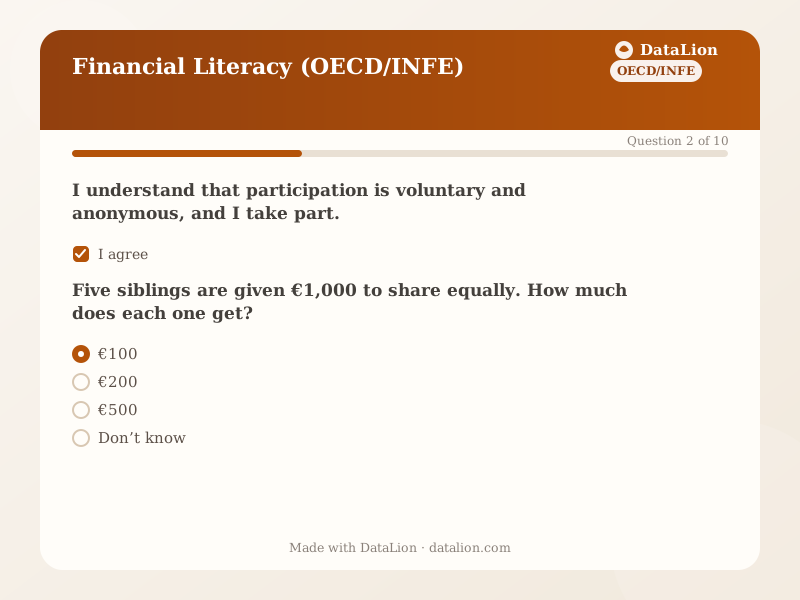
The OECD and its International Network on Financial Education developed a freely published questionnaire that lets countries measure financial literacy comparably. It has three parts: seven knowledge questions on interest, inflation and diversification, nine questions on actual behaviour, and three statements about basic attitudes to money. The three parts combine into a total from 0 to 21. That three-way split is the instrument’s real value: it shows whether someone is short on knowledge, routine or attitude – three gaps that call for entirely different responses.
When should you use this template?
This template is a great fit for:
- In financial education programmes run by banks, chambers and associations
- As an entry point to advisory conversations about provision
- As a repeatable progress check before and after a training course
Every question in this template
- 1Consent
I understand that participation is voluntary and anonymous, and I take part. *
- 2Single choice
Five siblings are given €1,000 to share equally. How much does each one get? *
- €100
- €200
- €500
- Don’t know
- 3Single choice
They have to wait a year for their share. Inflation over that year is 2%. What will they be able to buy with their share? *
- More than today
- The same as today
- Less than today
- 4Single choice
You lend a friend €25 in the evening and get exactly €25 back the next day. How much interest did they pay? *
- None
- A little
- Don’t know
- 5Single choice
You put €100 into a savings account paying 2% a year, with no fees or taxes. How much is in the account after one year? *
- €100
- €102
- €120
- Don’t know
- 6Single choice
And how much would be in the account after five years if the money is left alone? *
- More than €110
- Exactly €110
- Less than €110
- Don’t know
- 7Single choice
An investment with a high return is likely to be high risk. *
- True
- False
- Don’t know
- 8Single choice
It is usually possible to reduce the risk of investing by buying a wide range of different assets. *
- True
- False
- Don’t know
- 9Matrix
How much do the following statements apply to you? *
Strongly disagree Disagree Neutral Agree Strongly agree Before I buy something I carefully consider whether I can afford it. I pay my bills on time. I keep a close watch on my financial affairs. I set long-term financial goals and work towards them. Over the last twelve months I have actively been saving. - 10Matrix
And how do you see this in general? *
Strongly disagree Disagree Neutral Agree Strongly agree I find it more satisfying to spend money than to save it for the long term. I tend to live for today and let tomorrow take care of itself. Money is there to be spent.
Related survey templates
- CSRD Double Materiality Assessment (Stakeholder Survey)Stakeholders rate the ESRS topic areas by impact and financial materiality – the data basis for your CSRD materiality matrix.
- General FeedbackCollect quick and simple general feedback on your company, product or service – including an overall rating and recommendation.
- Big Five Personality Self-AssessmentA compact IPIP-based self-assessment of extraversion, agreeableness, conscientiousness, emotional sensitivity and openness – with a personal radar profile.
- Data & Analytics MaturityWhere does your organisation stand between spreadsheet islands and data-driven decisions? Five areas, a maturity profile and an instant report.
Frequently asked questions
How does the total of 21 come about?
Why are the attitude items reverse-scored?
Start with this template
Load the template into DataLion, adapt it to your brand and start collecting responses — GDPR-compliant, in minutes.